Compliance Strategy
EU AI Act August 2026: What the Compliance Deadline Actually Requires From Your Team

EU AI Act August 2026: What the Compliance Deadline Actually Requires From Your Team
On August 2, 2026, a major tranche of the EU AI Act becomes enforceable. Obligations for general-purpose AI (GPAI) providers, high-risk AI system requirements, and deployer responsibilities all take effect on that date.
That is roughly 17 weeks from today.
If your employees use ChatGPT, Claude, or Gemini - and statistically, they do - this deadline applies to your organization. Not in the abstract. Not eventually. In four months.
This post breaks down what the August 2026 deadline actually requires, who is responsible for what, and what your compliance team should be doing right now. This is not legal advice, but it is a practical, article-by-article guide to help you separate real obligations from regulatory noise.
What becomes enforceable on August 2, 2026
The EU AI Act (Regulation 2024/1689) entered into force on August 1, 2024. It uses a phased enforcement timeline. The February 2025 milestone banned prohibited AI practices. The August 2025 milestone applied governance and notification rules.
August 2, 2026 is the big one. It brings the full weight of the regulation online:
GPAI model obligations (Article 53) become enforceable
High-risk AI system requirements (Articles 6-51) take effect
Deployer obligations (Article 26) become binding
The European Commission gains enforcement powers, including the ability to levy fines
If your organization provides, deploys, or uses AI systems in the EU market, August 2 is your compliance deadline.
The obligations in plain language
Regulatory text is dense by design. Here is what the key articles mean in practice for a company whose employees use AI tools like ChatGPT every day.
Article 53: Transparency requirements for GPAI providers
Article 53 places obligations on providers of general-purpose AI models -- companies like OpenAI, Anthropic, and Google. They must:
Maintain technical documentation describing training and testing processes
Provide downstream users with information sufficient to comply with their own obligations
Implement a copyright compliance policy consistent with EU law
Publish a sufficiently detailed summary of the training data
What this means for you: If you only use ChatGPT or Claude (rather than building and distributing your own GPAI model), Article 53 obligations fall on OpenAI or Anthropic -- not on you. But you should verify that your AI provider is compliant, because their non-compliance creates risk exposure for your organization. Ask your AI vendors for their Article 53 documentation. If they cannot provide it, that is a red flag.
Articles 6 and Annex III: High-risk classification
The AI Act defines "high-risk AI systems" in Article 6, with Annex III listing the specific use cases. These include AI used in:
Employment and worker management (recruitment, performance evaluation, task allocation)
Access to essential services (credit scoring, insurance pricing)
Law enforcement and border control
Education and vocational training (scoring, admissions)
Critical infrastructure management
What this means for you: If your organization uses AI tools for any of these purposes -- even if the tool itself is a general-purpose system like ChatGPT -- the use case may trigger high-risk classification. A consulting firm that uses ChatGPT to screen resumes is deploying a high-risk AI system, even though ChatGPT itself is a general-purpose tool. Classification depends on what you do with the AI, not just what the AI is.
Article 9: Risk management systems
Organizations deploying high-risk AI systems must establish and maintain a risk management system. This is not a one-time assessment. Article 9 requires a continuous, iterative process that includes:
Identifying and analyzing known and reasonably foreseeable risks
Estimating and evaluating risks that may emerge during intended use and foreseeable misuse
Adopting risk mitigation measures
Testing to ensure the system works as intended
What this means for you: If any of your AI use cases fall under Annex III, you need a documented risk management process -- not just a risk register, but an active system that tests, evaluates, and mitigates risks on an ongoing basis. "We told employees to be careful" is not a risk management system.
Article 10: Data governance
For high-risk AI systems, Article 10 requires that training, validation, and testing datasets meet specific quality criteria. Data must be relevant, sufficiently representative, and as free of errors as practically possible.
What this means for you: If you fine-tune or customize AI models on company data, data governance requirements apply directly. If you use off-the-shelf tools like ChatGPT, your data governance obligation shifts to what data you send into those systems -- particularly personal data. Every prompt containing names, email addresses, client information, or employee data is a data input that your organization controls. Governance means knowing what data goes in and having processes to ensure it should.
Article 12: Record-keeping
Deployers of high-risk AI systems must keep logs of the system's operation. These logs need to be retained for a period appropriate to the intended purpose of the system, and must be sufficient to enable monitoring of the system's operation and post-market review.
What this means for you: If you deploy high-risk AI, you must be able to show regulators what the system did, when, and with what data. "We do not track how employees use ChatGPT" is a compliance gap, not a neutral position.
Article 26: Deployer obligations for high-risk AI systems
Article 26 is where the obligations hit companies that use -- not build -- AI systems. If your organization deploys a high-risk AI system, you must:
Use the system in accordance with the provider's instructions
Assign human oversight to individuals who are competent, trained, and authorized
Ensure input data is relevant and sufficiently representative for the intended purpose
Monitor the system's operation and report serious incidents
Conduct a data protection impact assessment (DPIA) where required under GDPR
Inform affected individuals that they are subject to a high-risk AI system's decisions
What this means for you: Even if OpenAI built ChatGPT, your organization is the deployer when employees use it for high-risk tasks. The deployer obligations belong to you. Human oversight cannot be optional. Monitoring cannot be absent. And if a DPIA has not been done, that is a gap that needs closing before August.
Provider vs. deployer: Who is responsible for what
This distinction is the single most misunderstood element of the AI Act. Many organizations assume that because they did not build ChatGPT, the AI Act does not apply to them. That is wrong.
Here is how obligations split:
Obligation | Provider (e.g., OpenAI, Anthropic, Google) | Deployer (your organization) |
|---|---|---|
Technical documentation (Art. 53) | Must provide model documentation | Must verify provider compliance |
High-risk classification (Art. 6) | Must classify if placing on market | Must assess if use case triggers classification |
Risk management (Art. 9) | Must build risk management into the system | Must implement risk management for deployment context |
Data governance (Art. 10) | Must ensure training data quality | Must govern data inputs (prompts, uploads) |
Record-keeping (Art. 12) | Must enable logging capabilities | Must keep operational logs |
Human oversight (Art. 14) | Must design for human oversight | Must assign trained personnel for oversight |
Transparency (Art. 13, 50) | Must provide usage instructions | Must inform individuals subject to AI decisions |
DPIA (GDPR Art. 35) | N/A at provider level for your use case | Must conduct if processing personal data at scale |
Incident reporting (Art. 26(5)) | Must report safety incidents to authorities | Must report serious incidents involving their deployment |
The key takeaway: providers build compliant systems. Deployers use them compliantly. Both carry obligations. The AI Act does not let you outsource responsibility by outsourcing the technology.
Practical timeline: What should already be done, what must happen by August
Should already be completed (Q1 2026)
Awareness training for leadership and compliance teams on AI Act basics
Initial inventory of AI tools in use across the organization
Identification of potential high-risk use cases under Annex III
Review of existing AI vendor contracts for compliance provisions
Must be completed by August 2, 2026
Full AI system inventory with risk classifications
Risk management system documented and operational for high-risk deployments
DPIAs completed for high-risk AI use cases involving personal data
Human oversight roles assigned, trained, and documented
Record-keeping and monitoring infrastructure in place
Employee AI usage policies published and training delivered
Technical safeguards implemented for data inputs to AI systems
Incident reporting procedures established
Penalties for non-compliance
The AI Act establishes a tiered penalty structure under Article 99:
Prohibited AI practices (Art. 5 violations): up to EUR 35 million or 7% of global annual turnover, whichever is higher
High-risk and deployer obligations (Art. 6-51 violations): up to EUR 15 million or 3% of global annual turnover
Misleading information to authorities: up to EUR 7.5 million or 1% of global annual turnover
For SMEs and startups, fines are capped at the lower of the fixed amount or the percentage-based calculation.
These are maximum figures. Actual fines will be determined by the severity of the infringement, the degree of cooperation with authorities, and the measures taken to mitigate harm. But the message is clear: the EU is treating AI governance with the same enforcement seriousness as data protection under GDPR.
7 concrete steps your compliance team should take now
Seventeen weeks is not a lot of time. Here is a prioritized action plan.
1. Inventory all AI tools in use -- including shadow AI
You cannot govern what you do not know about. Conduct a comprehensive audit of every AI tool in use across your organization. This includes licensed enterprise tools, but more importantly, it includes the tools employees are using without IT's knowledge.
According to Cyberhaven's research on shadow AI, 73.8% of ChatGPT usage in the workplace happens through personal, non-corporate accounts that lack enterprise security and privacy controls. For Gemini, that figure is 94.4%. Your official vendor list is almost certainly incomplete.
Survey employees directly. Review network logs. Check browser extension deployments. The goal is a complete picture of AI usage -- sanctioned and unsanctioned -- before you can classify risk.
2. Classify risk levels per Annex III
For each AI tool and use case identified in your inventory, determine whether the use case falls under one of the high-risk categories in Annex III. Focus on the use case, not the tool. ChatGPT used for drafting marketing copy is not high-risk. ChatGPT used for screening job applicants likely is.
Document your classification rationale. If a use case sits in a gray area, classify conservatively. Regulators will not give credit for optimistic interpretations.
3. Document data flows
For every AI tool in your inventory, map the data flow: what data goes in (prompts, file uploads, integrations), where it is processed (provider's servers, geographic location), what the provider does with it (training, retention, sub-processing), and what comes back out.
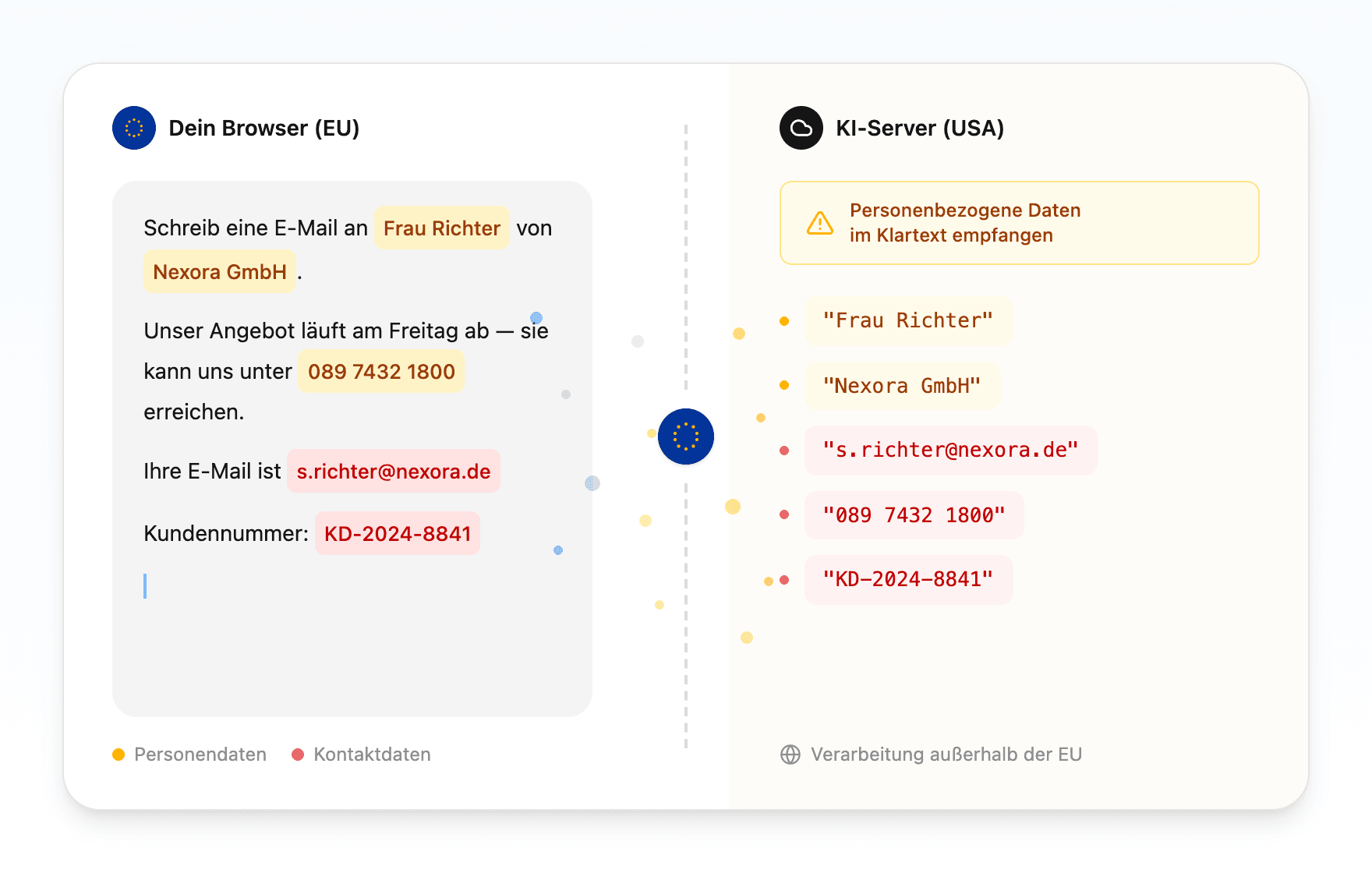
This exercise often reveals uncomfortable truths. Employees paste client names, contract terms, financial figures, and personal data into AI prompts daily. If that data flows to a US-based provider, you have a GDPR cross-border transfer issue on top of the AI Act obligations. Our post on why every ChatGPT prompt is a data transfer covers this in detail.
4. Implement technical safeguards for personal data
Policy alone does not prevent data leakage. If an employee can paste a client's personal information into ChatGPT, telling them not to is not a sufficient safeguard -- especially under the AI Act's requirement for "appropriate technical and organizational measures."
Technical controls include:
On-device anonymization of personal data before it reaches AI providers
Data loss prevention (DLP) tools configured for AI workflows
Enterprise AI deployments with data processing agreements and geographic restrictions
API-based access with logging and content filtering
The strongest safeguards are those that operate without relying on employee behavior. If PII is automatically anonymized before it leaves the browser, the compliance exposure shrinks to near zero for that data flow -- regardless of what the employee intended to type. For a practical guide on implementing these safeguards, see our post on how to use ChatGPT safely at work.
5. Train employees
Article 4 of the AI Act explicitly requires that personnel involved in the operation and use of AI systems have sufficient AI literacy. This is not optional and it is not covered by your annual data protection training.
Effective training should cover:
What the AI Act requires and why it matters
Which AI tools are approved for use and under what conditions
What data may and may not be entered into AI systems
How to recognize high-risk use cases
How to report incidents or concerns
What technical safeguards are in place and how they work
Document the training, including attendance, content covered, and date delivered. Regulators will ask.
6. Establish monitoring processes
For high-risk deployments, Article 26 requires ongoing monitoring. This means:
Regular audits of AI system usage patterns
Periodic review of risk assessments
Incident tracking and reporting procedures
Performance monitoring of AI outputs for bias, accuracy, and reliability
For non-high-risk deployments, monitoring is still good governance practice and demonstrates a mature AI compliance posture. At minimum, track which tools are in use, what volume of data flows through them, and whether usage patterns are changing.
7. Prepare documentation for regulatory inquiries
When a regulator asks about your AI governance posture -- and after August 2, they will -- you should be able to produce:
A complete inventory of AI systems in use
Risk classification documentation for each system and use case
Risk management system documentation (for high-risk deployments)
DPIAs for high-risk AI processing involving personal data
Employee training records
Data processing agreements with AI providers
Technical safeguard documentation
Incident logs and monitoring reports
Compile this documentation now, while you have time to identify and fill gaps. Assembling it under time pressure during a regulatory inquiry is a recipe for incomplete answers and increased scrutiny.
The role of technical controls in your compliance posture
It is worth noting how specific technical measures address multiple regulatory requirements simultaneously.
On-device anonymization of personal data -- where PII is detected and replaced with placeholders before a prompt ever reaches an AI provider -- directly supports several obligations. It advances data minimization under GDPR Article 5(1)(c). It reduces cross-border transfer risk under GDPR Articles 44-49 by ensuring personal data never leaves the local device. It provides a demonstrable technical safeguard for AI Act compliance, particularly around data governance (Article 10) and the deployer's obligation to ensure appropriate input data (Article 26). And it creates a defensible position in the event of a regulatory inquiry: the organization can show that a technical control was in place to prevent personal data from entering AI systems, regardless of individual employee behavior.
This is not about any single tool. It is about the principle that compliance built into the technology stack is more defensible than compliance built on policies that employees may or may not follow.
Compliance readiness self-assessment
Answer these 10 questions honestly. Each "no" represents a gap that should be addressed before August 2, 2026.
Do you have a complete inventory of all AI tools in use across your organization, including personal accounts and unsanctioned tools?
Have you classified each AI use case against the high-risk categories in Annex III of the AI Act?
Have you mapped the data flows for each AI tool -- what data goes in, where it is processed, and what the provider does with it?
Do you have technical safeguards in place to prevent personal data from being sent to AI providers without appropriate controls?
Have you conducted DPIAs for AI use cases that involve processing personal data, particularly at scale or for high-risk purposes?
Have you assigned and trained individuals responsible for human oversight of high-risk AI deployments?
Do you have a documented risk management system for high-risk AI use cases that includes ongoing monitoring and mitigation?
Have all employees who use AI tools received AI Act-specific training covering approved tools, data handling rules, and incident reporting?
Do you have data processing agreements with your AI providers that address AI Act requirements, data retention, and geographic processing restrictions?
Can you produce a complete documentation package for a regulatory inquiry within 48 hours -- including inventories, risk assessments, DPIAs, training records, and incident logs?
0-3 "yes" answers: Critical gaps exist. Prioritize steps 1-4 from the action plan above immediately.
4-6 "yes" answers: Foundation is in place but significant work remains. Focus on the gaps and aim to close them within 8 weeks to allow time for testing and refinement.
7-9 "yes" answers: Strong position. Address remaining gaps and conduct a dry-run regulatory inquiry exercise to stress-test your documentation.
10 "yes" answers: Excellent. Maintain your processes and monitor for AI Act implementing guidance from the European Commission that may require updates.
FAQ
What is the EU AI Act?
The EU AI Act (Regulation 2024/1689) is the European Union's comprehensive regulatory framework for artificial intelligence. It classifies AI systems by risk level -- from prohibited practices to high-risk to limited and minimal risk -- and imposes corresponding obligations on providers and deployers. It is the first major AI-specific regulation globally and applies to any organization that places on the market, puts into service, or uses AI systems within the EU.
When does the EU AI Act take effect?
The AI Act entered into force on August 1, 2024, but its obligations apply in phases. Prohibited AI practices have been banned since February 2, 2025. Governance and notification obligations applied from August 2, 2025. The major tranche -- including GPAI provider obligations, high-risk system requirements, and deployer obligations -- becomes enforceable on August 2, 2026. Certain obligations for specific high-risk systems (Annex I) have a later deadline of August 2, 2027.
Does the EU AI Act apply to ChatGPT?
Yes. ChatGPT is built on a general-purpose AI model, which means OpenAI has provider obligations under Article 53. But the AI Act also applies to organizations that use ChatGPT. If your company uses ChatGPT for a purpose that falls under the high-risk categories in Annex III -- such as employment decisions, credit assessments, or educational scoring -- your organization has deployer obligations under Article 26. Even for non-high-risk use, general governance expectations around transparency and AI literacy (Article 4) apply.
Who enforces the EU AI Act?
Enforcement operates at two levels. The European Commission's AI Office enforces obligations related to GPAI models (Article 53 and beyond). National authorities in each EU member state enforce obligations for high-risk AI systems, deployer requirements, and prohibited practices. This mirrors the GDPR enforcement model, where national data protection authorities enforce the regulation within their jurisdictions.
What is the difference between a provider and a deployer under the AI Act?
A provider is the entity that develops an AI system or GPAI model and places it on the market or puts it into service -- for example, OpenAI (ChatGPT), Anthropic (Claude), or Google (Gemini). A deployer is any entity that uses an AI system under its authority -- for example, a consulting firm that uses ChatGPT for client work, or an HR department that uses an AI tool for candidate screening. Both providers and deployers have obligations under the AI Act, but the obligations differ. Providers must build compliant systems. Deployers must use them compliantly and maintain oversight, monitoring, and documentation.
The August 2, 2026 deadline is not a distant milestone. It is 17 weeks away, and the regulatory expectations are specific and enforceable. Whether you are a DPO mapping your AI governance strategy or a team lead trying to figure out what you can and cannot do with ChatGPT, the time to act is now -- not when the enforcement notices start arriving.
If protecting personal data in AI prompts is part of your compliance plan, Rehydra anonymizes PII on-device before it reaches any AI provider. No data leaves your browser. The extension is free, open source, and available for Chrome and Firefox.